Posts

Showing posts with the label writers festivals

SCBWI Sydney Conference: Reflections on Reporting
Image
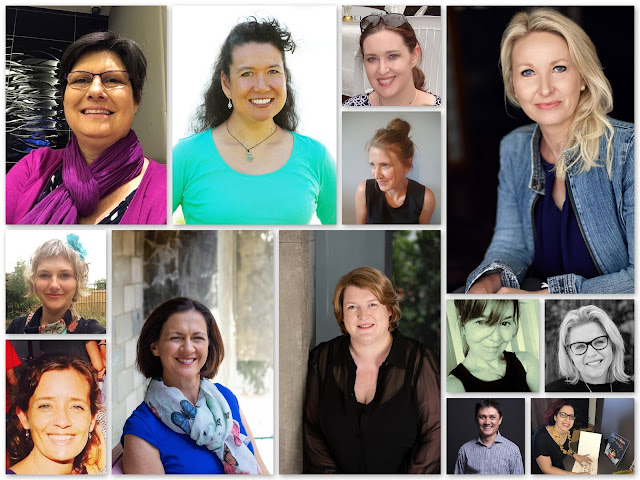
For the last few SCBWI Australia East & New Zealand Conferences, I've been involved as a Roving Reporter and for the last two, including the most recent 2019 Conference in Sydney in February, I had the absolute good fortune of assuming the mantel of Head Blogger, aka Media Coordinator, aka Head Gardener, aka Rocking Rover. Not bad for one of the world's biggest Luddites. Fortunately, coordinating social media feeds, compiling a comprehensive blog log of every detail of the conference and directing a merry band of roving reporters is not just a matter of operating a smart phone - thank goodness! We'd be reading conference reports on slabs of slate if it were. Why I did it One of the most satisfying aspects of this role is the opportunity to nurture a fertile group of talented women (and man!) and witness the creative fruits of their labour flourish into useful, usable resource. (Yes, I adopted a slight flora turn of phrase for the blogging event this year.) Ea...

Bibliotherapy - It's Place in Children's Literature AFCC Sessions Part 9

Image
As weeks slip away into months I want to share one last session round up from my time in Singapore at the Asian Festival of Children's Content . It is the session I was asked to present on Bibliotherapy as part of the Writer's and Illustrator's Conference . My objective was to: Explore the value of creating bibliotherapy themed diverse picture books (PBS) and debate their usefulness in combating various social issues affecting children. To discuss what works, what doesn't and why. This sounds straight forward enough but past experience has shown me that when you add the word therapy to anything relating to Kids' Lit, it has an immediate polarising effect; people either love the term and what it infers or they are vehemently against its implications. So what exactly is Bibliotherapy and its implications? Melissa Tan's impression of my session - she tells me, she was too involved in the topic to illustrate profusely. I first introduced delegates t...

Delving Deeper into the Art of Story Telling - AFCC Sessions Part 3

Image
My conference triage is reasonably simple: if I manage to glean a new sliver of information that enables me to improve my craft or  happen upon a revelation that deepens my understanding of story telling or  experience affirmation of a belief or method I am already practising, then I feel I have gained something useful. The following round-up highlights some of the sessions I attended while swanning around the Asian Festival of Children's Content this year. Deep Point of View (DPOV): What is it and How to Write It with Kathleen Ahrens  Kathleen encouraged us to first re investigate our Intention - why we write. Knowing that then allows us to engage with the readers' emotions and therefore establish, DPOV. She introduced us to different POV Characters and the tenses and view points they can be portrayed in for example, first person, third person, second person etc. as narrator omniscient multiple viewpoints  single major viewpoint Deep Point o...

A word about Selfies

Image
The science of the evolution of words is a deeply fascinating and curious thing. So fascinating and curious that author Nick Earls took the idea of etymology and fashioned it into not one, not two but three amazing adventure books for kids . But (lots) more on that another day... The concept of word play and word origin is equally as absorbing for writers as for readers and led me to ponder on the development of the word 'selfie '. Selfie : a picture of a person taken by that person. (usually badly if that person's name is Dimity) How did the term 'self-portrait photograph' become reduced to such a bland, throw away two syllable text term? When did we become a race of need-it-yesterday, don't-have-time-to-speak-full-words narcissistic androids? And if we are that desperate for a shot of our own mugs, what is wrong with using a tripod or the old fashioned method of accosting a complete stranger and risking camera abduction in the name of getting behind th...

Survival of the Fittest

Image
Any wildebeest will tell you that the Key to Survival is Adaptation . Eat or be eaten, prey or be preyed upon. But how exactly does this translate to writing and in particular children's writing? And how does adaption lead to success? Let's have a brief search through the savannah for the answers... 1. Adapt your hunting and housekeeping requirements to the bare basics. Pretty soon your family will Adapt to the idea that the floor of their den looks far better with dust than without. Teach them how to hunt their own wildebeest and encourage them to watch Masterchef more. 2. Adapt with the times. Study the herd. Recognise and acknowledge trends. You don't have to follow them and write what every one else is writing. Far better not to. But by astute listening, reading and watching you will soon be able to figure out what (still) works, sells and more importantly is favoured by readers. One of my favourite methods is to stand quietly in the children's section of an...